I love to use Pinterest as my virtual bulletin board. As you might guess many of my pins are sewing related. Click here to see what fun stuff I've found and pinned to different sewing boards.

Tuesday, October 22, 2013

Jeans Sewing: JeanAge WaistBand


JeanAge WaistBand
Sing it to the song (and especially the chorus)  of The Who’s, Baba O’Riley*
(That song is often known as Teenage wasteland)


Out here in the fashion lab...I fought for that fly front
Then got my back into drafting – what comes above
I don’t need to fight
To prove I’m right
I just gotta get the fit tight

Jean age waistBand
It's only a Jean age waistBand
Jean age waistBand, oh yeah
Jean age waistBand
It’s all stitched now

~ ~ ~
Resources
A great fly-front zipper youtube video, I've used several times by "Fashion SewingBlogTV" http://www.youtube.com/watch?v=91gO3iE7YOU

Baba O’Riley is The Who song that starts out
Out here in the fields
I fought for my meals
I get my back into my living
I don't need to fight
To prove I'm right
I don't need to be forgiven
 the chorus

Teenage wasteland!
It's only teenage wasteland.
Teenage wasteland, oh yeah.
They're all wasted.


Saturday, October 19, 2013

Jeans Sewing: Looking Jeans'y - A Jeans Fit Garment (fit)

One day I put them on and...
Even without a waistband
I could see they were starting to
look like real jeans.
Drafting, drafting drafting. Pattern drafting is a great new learning experience and, oh yeah, it takes a lot of time.

At some point I just wanted to know how the pattern I was creating over and over in muslin was going to look in the real deal ....
Denim

And, just as I learned with my jeans-style denim skirt, I found that the denim draped totally differently than the muslin. More challenging yet, I was working this time with denim with lycra. Guess who looked like the saggy baggy elephant? No, sorry. I just couldn't take a photo.

How many times did I take in the seams? Four on the side seam and twice on the inseam. 

Then one day I put them on and low and behold, they were starting to look like jeans!

It's times like these that keep me...

Enchanted by Sewing

Wednesday, October 16, 2013

Vionnet and Ericson Inspired my Circular Work (Draping)

Back of imaginary jacket I created from a full circle
Sandra Ericson's recent talk on her fashions, inspired by the work of Madeline Vionnet, has me looking at dress forms with a new eye.

In a recent draping class (our midterm actually) we were asked to fold a square of fabric - I chose a 45 x 45 square, round it off into a circle and see what we could create. 

This is one of my designs. In this case I cut a line along one radian of the circle.


Here's the fantasy front
I like how it swings!
I wonder if that sleeve I created by simply pinning a line up from the edge, part way, would fit me? And would that tuck coming down from the shoulder at an angle fall well, and be comfortable on my body?

I liked the way the cuff rounded up from the base of the circle. That is something I plan to try in a real garment.

I also plan to try out the multiple layers of hem, at different levels. Some kind of sheer floaty fabric - like voile or silk organza - would  be nice for that. Wool jersey would be good too, but with our climate, I'd get very little use out of a jacket made from that.


My favorite features?
The triangle pocket, the diagonal shoulder tuck,
and the curved cuff.

The swinging lapel in the front, gave me the opportunity to create a little chest pocket at the top, another feature I'm definitely going to integrate into a real jacket!


Playing with circles in fashion lab is the kind of thing that keeps me,
Enchanted by Sewing!


~ ~ ~ 
Resources

Sandra Ericson and Madeline Vionnet - Modern fashion inspired by historical beauties

http://meencantacoser.blogspot.com/2013/10/to-drape-or-not-to-drape-no-question.html

If this were a real, complete garment - which it's not - it would be a Zero Waste Pattern. Zero Waste designs are something I'd like to create. Here's an article about them, I found on Sandy Ericson's site.
dn.shopify.com/s/files/1/0131/0182/files/Zerowaste.pdf?1471

Sunday, October 13, 2013

Jeans Sewing: Drafting a Basic Pants Pattern


Learning to create the pattern  for my first pair of jeans, certainly has me
Enchanted by Sewing!

1) Summary - What I've learned
2) History
3) Resources
~ ~ ~
1) Summary - What I've Learned
* Have now drafted my Basic Pants Pattern
* Jeans Pattern will be a variation on the Basic Pants Pattern
* A lot of time!
* Basics - Used charts in book (see Resources below) to draft a basic pants block. Created first pass at pattern from that block. 
* A double tracing wheel-  carbon paper to fabric tracer tool - (like Clover Double Tracing Wheel) was very useful for adding a 1 inch seam allowance to the original pants block. The reason I couldn't make that work before - lousy carbon paper from local store. Clover Chacopy transfer paper works much better. I bought both on the web.

I continue to use these time saving, transfer, seam allowance adding, tools on each iteration of the pattern.

* Alteration Time - Time is the key word here. I continue to spend a lot of it on this project
* Alter muslin, alter pattern, study results with fit buddy or in the mirror (for the front anyway). Repeat these steps until done.
* Fit buddy eyes me and suggests alterations
* Studying typical alterations is very useful - even those that don't sound like my fit issues help me to think through those I need to make
* Not all alterations are standard. Studying them helps me to develop my eye, and use my own senses about what needs to change in each pattern and muslin draft
* Mirror is essential. I used masking tape on fit lines, so I could see them better in the mirror when I was working on my own between classes (this really only works when altering the front!). My teacher thinks masking tape drags down the muslin. In order to keep going on the project, I needed that masking tape!
* Straight of Grain (SOG) is essential, as well as perpendicular fit lines. When I make changes, I need to relate back to the original pattern and these lines provide those relative points.
* Drawing fit lines is essential - waist, upper hip, lower hip, crotch, thigh, knee, calf. They need to be dark enough to see them in the mirror when I try on the current muslin
* Fit lines below the crotch need to stay parallel with the floor!
* Watch that straight of grain!
* In the curvy parts of the body, fit lines and SOG will curve. That makes sense, when I think about it.
* Thread basting fit lines takes longer. I like using a dark pen that shows through both sides of the muslin better
* Staystitch the waist line. Use narrow elastic to tie muslin pants on at the waist. Leave open at front (where zipper would go) but draw on stitching lines and pin on there when trying on.
* This process takes a lot of muslin. When I try to conserve muslin, sometimes it just adds a lot more time

~ ~ ~
2) History

I've blogged/journaled many times about my determination to learn to sew jeans. In the summer I began this journey by working on jeans sewing techniques, but without the jeans! That is, I first sewed a jeans-style denim skirt

I had found myself intimidated by the many different, and new-to-me, skills involved in sewing jeans. When I sorted through what was keeping me from getting going, I realized that getting the fit right on a jeans pattern was a biggie, so I put that off and focused on materials and techniques - though I found fitting that skirt in heavy weight denim - versus the twill I'd used to test out the pattern - to be more work than I'd expected. I'm currently at work on the October Enchanted by Sewing Podcast, which will be an audio show about my experiences working on the jeans-style sewing skirt project. You can signup to be notified (no spam!) when monthly podcast episodes are released by visiting the show notes for the  Enchanted by Sewing Podcast.

This fall, I've begun working towards my first pair of actual jeans

I'm taking a pants drafting class in order to get a pattern that fits me. Alternatively, I could have worked on altering a commercial jeans pattern. There are several recommendations for jeans patterns others have tried, in the Pattern Review forum Make Your Own Jeans, You Can Do It! Several of those patterns, have detailed instructions about fitting the patterns to your figure type, as well as  many more sizes than are typical in Big-4 patterns.

I haven't ruled out using a commercial jeans pattern for a future jeans project (in fact I bought a couple when I was first considering taking this learning project on), but since I am a student in the Cañada Fashion Program, why not learn something about pattern drafting and fit in a classroom environment?

~ ~ ~
3) Resources
* Jeans Sewing: Skirting the Issue - Terminado!/Done! 
This blog/journal post summarizes the work I did to create my jeans-style denim skirt. This project got me started on the path to jeans sewing.


* The Enchanted by Sewing Podcast is an extension of this blog. It's a monthly Audio Show where I focus on sewing specific garment styles and interview other sewists. You can either listen right on the web (while you sew maybe!) or download it to a mobile device like an iPhone, Android or other mp3 player. http://www.enchantedbysewing.blogspot.com

* In pants drafting class, we're using the book Building Patterns, The Architecture of Women's Clothing by Suzy Furrer.


* Pattern Review: Make Your Own Jeans - You Can Do It!
http://sewing.patternreview.com/blog?s=1431483

Wednesday, October 9, 2013

Antique Threads - Up to Dating Ruffles and Teacups (Historic Inspiration)


If you listened to my July podcast from the fashion gallery of the Victoria and Albert (V&A) in London, you'll recall that I was in sewist heaven when it came to studying fashions in the V&A's collection.

I haven't even finished blogging about some of my ideas from that trip yet - thoughts on creating new looks based on gorgeous antique and retro garments I talked about and photographed in the V&A - before a new book purchase, Seventeenth and Eighteenth-Century Fashion in Detail: The 17th and 18th Centuries by Avril Hart and Susan North,  got me heading out to search the free on-web collection at the V&A museum, to look up more details from several historic beauties mentioned in this delicious book.


What's the appeal? Not only are were the
edges of these silk strips left raw, the gathered band
was also twisted in a sinuous pattern.
As a result, I have fallen for a dress. 

It's one of those sewing danger things, right? Bad enough when the inspiration garment is something I might wear only once to a wedding or a performance at the opera, but I had to get knocked over by an embroidered silk doozy from the late eighteenth century. 

We're talking here about twenty or thirty yards of silk. We're talking about major ruffles and teacups. We are talking about something that would not even fit through the door of the mini van!

It's the pinked and scalloped strips of silk on this gown** from the late eighteen century that have me itching to come up with a modern way to use this style of embellishment. But I haven't been able to see past the style of this lovely, but totally impractical for modern times (!) sack-back gown. I couldn't see it in a vest, jacket or skirt. OK, I could but the look would have been waaayyyy too fussy. 

.
I had forgotten, however, about this outfit*** I pinned on my Pinterest Historic and Retro Sewing Board. Me oh my, it gives me ideas for deploying that really cool ruffle. 

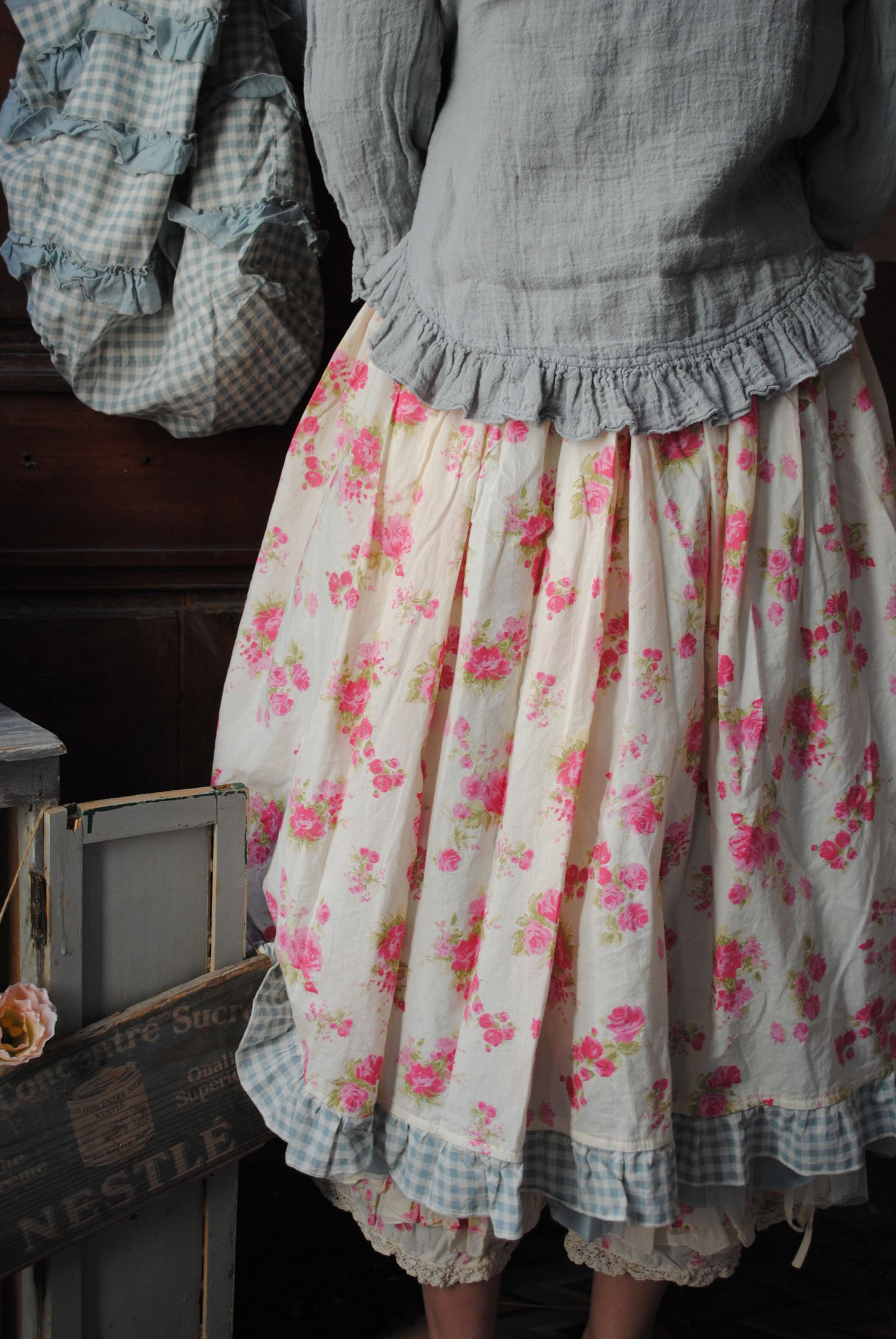
Can't you just see that snakey, raw edged, twisted, ruffle in a very light weight denim? I can. It's slithering along the edge of a nicely flowing denim shirt or jacket. Perhaps it's just a touch narrower. And in combination with something like this floral skirt in a lovely, fluid voile - or maybe a homespun style check or plaid like the trim on this skirt -, it would really hit the spot.

I bet you know how it goes. Historically inspired, modern fashion is the kind of sewing daydream that keeps me....
Enchanted by Sewing!
~ ~ ~
Resources


Search the V&A Collections http://collections.vam.ac.uk

** Details on and photos of the glorious gold sack-back gown at http://collections.vam.ac.uk/item/O127134/sack-back-gown-unknown/

I have several Pinterest sewing theme boards at http://www.pinterest.com/lrshimer/ You don't have to join Pinterest to look at them.


*** I'm not sure of the original context for this garment. I saw it on someone else's board. The only link that comes up for it is 
http://p7.storage.canalblog.com/76/26/647625/85282790_o.jpg

 ~ ~ ~ 
* Thanks Sponsors! *
* Thanks so much, to readers who sponsor the work of this blog and the Enchanted by Sewing Podcast, by purchasing books, ebooks and other products through links in this blog.

Thursday, October 3, 2013

To Drape or Not to Drape - No Question About It - Ericson Is Inspired by Vionnet: (historical and modern draping)

Vionnet made these gowns 
for the 
Duchess of Windsor
For Madame Vionnet, 
It was all about fabric and cut.

This past weekend I attended Artistry in Fashion (AIF)* at Cañada College in Redwood City CA (San Francisco Bay Area). This is the school with the excellent fashion department , where I have often mentioned I take sewing and fashion design classes.

I was really looking forward to hearing the keynote speaker, Sandra Ericson **, as my draping class teacher, Judith Jackson, has studied with Ms. Ericson  and dropped a lot of little hints about this designer's experiences studying the work and designs of Madeline Vionnet. Madame Vionnet, as you probably already know, was a famed french designer and queen of the bias cut. I knew I'd enjoy the talk, but had no idea that I'd walk away absolutely inspired to learn to cut and drape some bias of my own. 
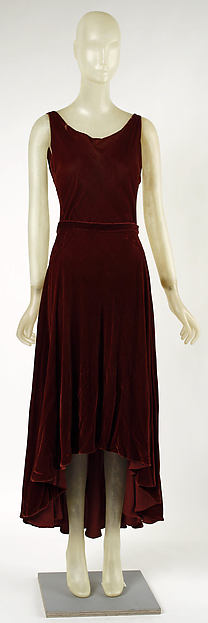
This Vionnet evening dress
makes me yearn
for a piece of silk velvet!

Having only just recently begun to learn about draping, I'm starting to get a sense of the fun involved in smoothing fabric over a dress form, capturing excess, and letting the material speak to me about where it wants to go and what it wants to do. So far in our first four working classes, we're still working with traditional straight of grain and cross grain goods. We haven't moved into bias land yet.

I can hardly wait.


Learning more about designing and sewing garments cut on the bias, is going to be another pathway that keeps this sewist, 
Enchanted by Sewing!
~ ~ ~
Talk and Draping Demo Notes 
* Very few pattern pieces used, often only one or two
* Bias expands and contracts to fit the body
* Though sewing is limited, these styles are not for beginners. Garment constructors should be "champion edge-finishers"!
*For Vionnet, it was all about fabric and cut.

Madame Vionnet was not so much a sewist as she was a "technician". She focused on cut and cloth, analyzing the construction of the cloth and ways that the fibers restricted movement  (Laurel reflects - it's about drape and sway. This reminds me of the Enchanted by Sewing podcast where I interviewed Susan S. and she described herself as a "Fashion Engineer"). 
* Sandra Ericson sometimes drapes wet. I wonder what kind of dress form she uses when she does this? I sure wouldn't drape wet on my foam core "Uniquely You" dress form! Might be OK on my duct tape dummy though...
* Ms. Ericson several times pointed out gussets she used in garments made from the patterns she designs. A couple of women behind me kept whispering, that they didn't know what a gusset is. I tore up a little piece of notebook paper and wordlessly clued them in. 

I think at one time, many home sewers knew about adding gussets for a little extra ease at key points, but in this age of commercial patterns people tend to be leery, or just unaware, of altering garments in this way.

* When you're draping, cut away what you're not going to wear
* Finished some edges with a serger and invisible thread (hem perhaps?)
* Noting S. Ericson's bolero jacket, reminiscent of Balenciaga, we learn he studied with Vionnet, tending to create garments in stiffer fabrics. Laurel thinks this pattern would make a very nice travel jacket.
* Vionnet's principle was to use nothing fake to support the shape of the garment. For example - no shoulder pads. If a sleeve needed more height, she might dart it, to make it stand up
~ ~ ~
Fabrics Used ....
on some of the sample garments displayed in Sandra Ericson's talk 
 Hold the fabric up, let it drop, and see how it hangs

*Rayon - Note rayon has a "high specific gravity" that drags a garment down (Laurel asks, Is that sometimes a good thing?)
* Rayon Twill (donut skirt)
* Silk Velvet (skirt, Komono Cool Top)
* Silk Noil - Laurel says Thai Silks (longtime business with a good reputation, in nearby Los Altos, has very nice silk noil and they sell on the web.
* Wool Crepe (the V- dress, the Midterm dress)
* Heavy Wool Coating (we noted how differently garments made with this fabric, hung versus more drapey materials)
* Light Weight Wool Cashmere
* Upholstery Fabric (the Measure Coast - no pattern - set of instructions purchased and you make it to measure. Includes those now, very familiar, gussets!
* S. Ericson likes hand woven fabrics. She encourages us to see how they hang down.
* Ms. Ericson often uses Nature's Way Muslin (Rocklin?) for making toiles/muslin's when draping, but uses others as well and is checking out a new one she's found.
~ ~ ~
Resources

Fashion Engineer for Work and Play - Snakes Alive Environmental Consultant by Day, Sewist by Night 
Learning about Vionnet's focus on the technical side of working with fabrics, reminded me of this interview with Susan S.

Dress Forms? What are those? How do I get one? Can I make it myself? How much does it cost and how much time does it take?
When you drape - unless you have the luxury of a live model - you generally use a dress form. In this episode of the Enchanted by Sewing Podcast, I describe my experiences creating two different kinds of dress forms. I also provide links to another show, where Lori,  of the Sew Forth Now Podcast, talks about the history of dress forms, as well as her  pre-made, adjustable dress form.
http://www.enchantedbysewing.blogspot.com/2013/09/ench-by-sew-12-dress-forms.html

Center for Pattern Design - Ms. Ericson's Digital Studio 
 Lots of Resources plus her own Patterns for Sale http://www.centerforpatterndesign.com

Of the models I saw in the the talk - I was most partial to the four-square dress, pyramid dress, and cocoon coat. These are not Big-4, slam-bang, mass-market, discount patterns. Inspired sewists are paying for the work of a pattern-design artist. Most patterns seem to range between $20 and $35, at this time.

One place you can see examples of  Vionnet's work, is by searching  the collection of the Met Museum
http://www.metmuseum.org/toah/works-of-art/C.I.46.4.24ab,25ab

Madeleine Vionnet book by Betty Kirke - Classic study on famed draper and technical artist. Includes 30 patterns. Warning, this book is not cheap, but would you get a ton of patterns in addition to the text, so why would it be? Sandra Ericskson mentioned it many times in her talk


Drape Drape by Hisako Soto
This affordable book looks like it might be a good approach to start playing around with draping
http://www.amazon.com/Drape-Hisako-Sato/dp/1856698416/ref=pd_sim_b_4

~ ~ ~
P.S. Next Years Keynote Speaker at Artistry in Fashion is Patti Palmer. You better believe I'll be attending again!

** Yes, Sandra is Lois Ericson's sister