I love to use Pinterest as my virtual bulletin board. As you might guess many of my pins are sewing related. Click here to see what fun stuff I've found and pinned to different sewing boards.
Showing posts with label Connie Amaden-Crawford. Show all posts

Friday, December 20, 2013

Draping Lucy - Terminado! New Dress and back to Rec Sewing


Lucy is the first garment I've
created  from a pattern I
made entirely myself, on my
custom dress form.

I haven't done any regular, recreational sewing all semester (one semester = 16 weeks) because I've been focused on the class work and final projects for my two fashion classes at Cañada College. The first class was Pants Drafting, taught by Lynda Maynard (that's the woman who knows what we really want to sew, and teaches us how to do it!)  In that class, I used drafting techniques,  and many fitting followups, to produce inumerable muslin garments, tissue pattern drafts, and my first pair of jeans. Can't wait to use that pattern again and again!

My second class was Draping. This class is excellently taught by Judy Jackson. Again I went through a lot of muslin, this time learning to design my own patterns by draping them in muslin fabric on a dress form, then creating tissue patterns from those draped garments. You may have seen some of my posts this fall that showed off some of the basic garment shapes I created on a standard sized 10 dress form (I called her Babs, a name that seemed appropriate for a mannequin who came to life in the early '60's). I also began draping on my own custom dress form that I created over the summer. 

When I last talked about my custom dress form I was calling her Colette, but I've since realized that she is really a Conchita
I found working with Conchita even more challenging than working with Babs, and Babs wasn't an easy customer. Was it because Conchita represented clothing I actually plan to wear? I'm not sure yet. But if I figure it out, I'll let you know!

Starting around midterm time, I spent several weeks creating a muslin sloper (a fitted bodice and fitted straight skirt) for Conchita. For some reason I found this very challenging, though I had produced the same garments for Babs. My teacher seemed to think that there should be the same amount of challenge, if only I was careful with my measuring. I worked very hard to be exact but all I can say is that it was much harder for me and just took a lot of time, muslin, tissue and patience.

Another view of Lucy
As you can see, I moved on from my sloper to make my first garment. I had originally planned to make a traditional shoulder-yoked, dropped shoulder, shirtwaist dress with a collar and front button plackets. I was of two minds as to whether the dress would have a separate skirt joined by a waistline seam or be a one piece dress. I was planning to use a beautiful piece of deep forest green silk noil (raw silk) that I have for that dress. In my mind the dress I was planning to drape was named Ivy. I'm still planning to take up with Ivy in the not to distant future. But I got distracted by Lucy....

I'll be writing more about the process of draping Lucy in upcoming postings in this journal. One thing I know I'll be reflecting on repeatedly, is learning to read the fashion fabric's story. This lesson came from my experiences in both my pattern-creation classes this semester. In both cases I saw that constructing beautiful garments is not just about designing a piece in my mind or on a sketch pad. It really comes down to watching the behavior of the fabric I've chosen to sew with, after it's cut out and initially put together on me or my custom dress form. Creating a muslin test garment is an important part of the pattern making process, but once I start the ball rolling with muslin, I then really have to listen to the story the actual material for that garment is telling me. That's what is going to guide me to bring the garment I'm sewing to life.

Learning to listen to, and read the fabric's story really keeps me
Enchanted by Sewing
~ ~ ~ 

Resources

You can drape on a person or on a dress form. When creating for ourselves, it's easiest to use the dress form approach!

In the September Enchanted by Sewing Audio Podcast Dress Forms Episode, I described my experiences creating two different dress forms. You can listen to this talk either online on the web, or you can download the show to your mobile device (like an iPhone, Android, etc.)
http://www.enchantedbysewing.blogspot.com/2013/09/ench-by-sew-12-dress-forms.html

I'm just beginning to learn the historic and modern art of draping. It's a very artistic experience !  I've begun to develop my skill set in a class taught through the Cañada College Fashion Department. I'll be continuing my draping journey by continuing to follow the richly illustrated draping tutorials and examples in our class textbook, The Art of Fashion Draping. This excellent, and highly regarded book, by Connie Amaden-Crawford has been in use for decades. both within the industry, and by home sewists. 

Thanks Sponsors! 
When you buy products through links in this blog, you support the regular work of this blog and The Enchanted by Sewing Podcast.

Wednesday, November 13, 2013

Draping: But What *Is* It? (pattern altering and design)

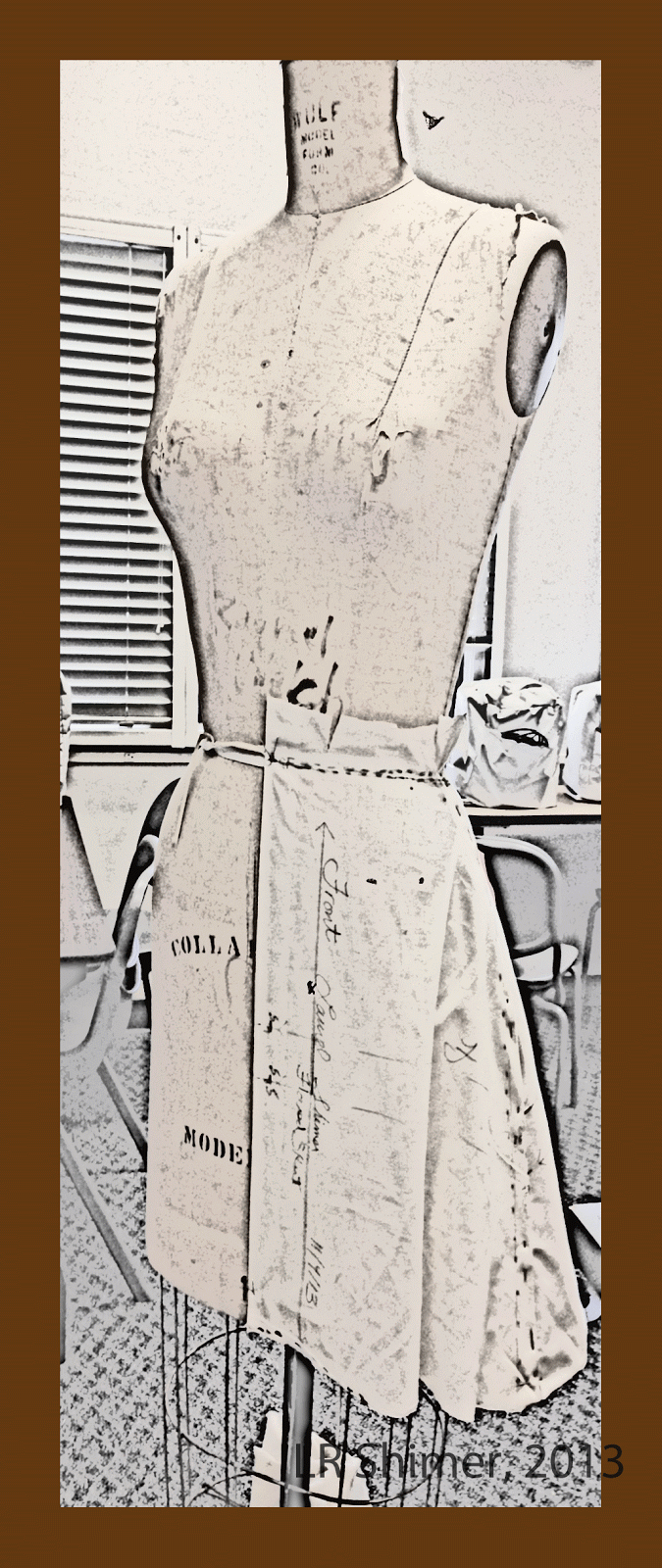
A flared skirt I draped in
Fashion Lab
You're right, that hem wasn't
yet even!
Before people sewed they draped. 
And we continue to drape today. 

Most of my buddies, both sewists and non-sewists, understand what I'm talking about when I say I bought a pattern, altered it to fit a little better, and sewed it up. But when I say I'm studying draping, they give me the funny look. When I explain what draping is, I get another look.

Draping is the most historic way of creating clothing. Long before people applied the first ancient bone needles and early threads to join pieces of fur or fabric together, they hung or draped clothing on themselves and others and found ways to fix those materials onto the body. 

You may have tied or wrapped stuff around your own or a dolls body at one point in your life, and achieved a serviceable garment. Ever tossed a hole-embellished sheet over your head, and been a ghost for Halloween? I know I achieved a lovely Roman goddess effect with a large blue sheet and a little twisting around my self and over one shoulder, back in sixth grade.

In most cases of early draping, the fabric was draped directly onto the body the piece of clothing was intended for. Eventually pins were added to hold things in place (If you can knap stone or bone to create an arrowhead, why not a pin?). By the time the Romans dominated the western world, many civilizations were using something along the lines of the Roman fibula, a kind of forerunner to the modern safety pin to hold longer clothes on. They were also pretty savvy about tying fitted workmanlike garments onto their bodies.

Stitching things in place came rather later in history. It was the tying, draping and arranging of fold and fabric that counted. 

Skipping forward quickly (did you know I'm an inveterate time traveller?) we find that though modern folks have invented the flat pattern method of clothing construction, clothing designers and sewists continue to use draping as either an alternate method of creating a pattern, or as a way of testing, altering or polishing the fit of a garment created with a flat pattern. 

I'm taking a draping class in order to develop skills I can use with my custom dress form. (You may also choose to buy dress forms that you can adjust to reflect your measurements.) That means I'll be better able to alter commercial patterns to fit me, in addition to beginning my journey into creating my own patterns. I also hope that someday I'll be bold enough to create a garment from scratch right on my custom form, just like the couture houses do for their high-end clients!

As I learn to drape, I'm learning more about this ancient art form, increasing my appreciation for historic garments, and developing a sense of why the lines of different pieces of clothing fall the way they do. 


Learning to drape, and studying the history of draping is the kind of thing that keeps me...
Enchanted by Sewing!


~ ~ ~
Resources

The profession known as a "draper", has an historical significance that goes back to medieval trade guilds. http://www.ask.com/wiki/Draper

You can drape on a person or on a dress form. When creating for ourselves, it's easiest to use the dress form approach!

In the September Enchanted by Sewing Audio Podcast Dress Forms Episode, I described my experiences creating two different dress forms. You can listen to this talk either online on the web, or you can download the show to your mobile device (like an iPhone, Android, etc.)
http://www.enchantedbysewing.blogspot.com/2013/09/ench-by-sew-12-dress-forms.html


I'm just beginning to learn the historic and modern art of draping. It's a very artistic experience !  I've begun to develop my skill set in a class taught through the Cañada College Fashion Department. I'll be continuing my draping journey by continuing to follow the richly illustrated draping tutorials and examples in our class textbook, The Art of Fashion Draping. This excellent, and highly regarded book, by Connie Amaden-Crawford has been in use for decades. both within the industry, and by home sewists. 

Thanks Sponsors! 
When you buy products through links in this blog, you support the regular work of this blog and The Enchanted by Sewing Podcast.

Thursday, November 7, 2013

Waistlines: Designing Without - The No-Waistline Look

This gorgeous no-waistline frock is from the
This month I'm musing on the different waistline levels I select to sew.

The no-waistline look in this Dolce & Gabbana dress, sets off the gorgeous fabric* the designer used. No sewist would want to cut through this print!

When we choose a waistline style - or lack of one - by selecting a pattern, designing a flat pattern, or designing by draping our own pattern, we are choosing where the garment, or a part of the garment, hangs from on the body for which we are sewing. 

In this case, where there is no waistline, the garment hangs from the shoulders. The folds of this garment drape from the high bust point. If the model were more curvaceous in that area, the folds could hang differently, and the way that the print is displayed might be different too. 

We drape material on human-shaped dress forms, to see how different body types affect the fall - or drape- of a particular piece of fabric. We also look at how the material's textures and prints will hang on a similarly shaped human form.

~ ~ ~
Resources
I'm just beginning to learn the historic and modern art of draping. It's a very artistic experience !  I've begun to develop my skill set in a class taught through the Cañada College Fashion Department. I'll be continuing my draping journey by continuing to follow the richly illustrated draping tutorials and examples in our class textbook, The Art of Fashion Draping. This excellent, and highly regarded book, by Connie Amaden-Crawford has been in use for decades. both within the industry, and by home sewists. 

Thanks Sponsors! 
When you buy products through links in this blog, you support the regular work of this blog and The Enchanted by Sewing Podcast.

Fabric Notes
* The print in the Dolce & Gabbana frock above is quite reminiscent of one of the Alexander McQueen fashions I talked about in the fashion gallery audio podcast tour I shared from the Victoria and Albert (V&A) Museum in London last summer. In that tour, I give catalog information, so that listeners can use links from the show notes to look up further museum cataloging information about, and find images of, garments that were mentioned during that tour. 

For links to the V&A collections database, follow the show notes link at http://enchantedbysewing.blogspot.com/2013/07/ench-by-sew-010-v-fashion-gallery-tour.html

~ ~ ~
You May Also Like 

Waistlines:  What's Natural? (Haiku)
http://meencantacoser.blogspot.com/2013/11/waistlines-whats-natural-haiku.html

Enchanted By Sewing Audio Podcast: Dress Forms http://www.enchantedbysewing.blogspot.com/2013/09/ench-by-sew-12-dress-forms.html

My Virtual Bulletin Boards on Pinterest

Draping Inspiration Images and Articles - http://www.pinterest.com/lrshimer/draping-inspiration/

Dress Forms Articles, Arty, Make Your Own, Etc - http://www.pinterest.com/lrshimer/dress-forms/

I have several other sewing related Pinterest boards - http://www.pinterest.com/lrshimer/boards/