I love to use Pinterest as my virtual bulletin board. As you might guess many of my pins are sewing related. Click here to see what fun stuff I've found and pinned to different sewing boards.
Showing posts with label time travel. Show all posts

Thursday, January 26, 2017

EnchBySew-51: Betsey Johnson - Following a Vintage Alley Cat

Click on this link in iTunes    to download the 51'st episode of the Enchanted by Sewing Audio Podcast,  produced in January of 2017.

Or listen directly on the web by clicking on http://traffic.libsyn.com/enchantedbysewing/FINALcastBetseyJohnsonAlleyCat_LAURELSHIMER.mp3

Not long after I finished up my front pleated, mid-weight,  denim trousers. Suddenly hit … that
I was taking my sewing inspiration from trousers I’d sewn in high school – which for me was quite some time ago.

And that inspiration came from fashion designer Betsey Johnson.

What will you hear in this month’s show?

1) Vintage Alley Cat – The Original Betsey Johnson
– In which Laurel is whisked away on a time travel jaunt, reminding her that not all of her sewing projects come from the pages of the here and now.


2) Betsey Briefly – A Timeline
a. Including  a bit about how Betsey’s designs iinfluenced my own coming of age sewing
https://en.wikipedia.org/wiki/Youthquake_(movement)

Great article about Betsey in Vogue - lots of interviews with folks who have known her for a long time
http://www.vogue.com/13262702/betsey-johnson-cfda-awards/

https://en.wikipedia.org/wiki/Betsey_Johnson

Betsey is still going strong ! http://www.betseyjohnson.com

3) -Trousers Inspired by an Alley Cat
In which  A woman draws inspiration from her teenaged sewing self. Talk about time travel!

a. The original Betsey Johnson pattern  - way back when - was B3289
http://meencantacoser.blogspot.com/2017/01/vintage-flared-trousers-alley-cat.html

b. Further ideas for sewing inspired by Betsey Johnson. The Jamie M pattern, I mentioned in this section, - way back when - was B6533 Here's a posting I did showing a little bit of what I talked about in the 'cast. http://meencantacoser.blogspot.com/2017/01/laced-up-empire-alley-cat-more-betsey.html

c. Different kinds of pockets - https://www.craftsy.com/blog/2014/02/kinds-of-pockets/


Monday, November 25, 2013

Marie Antoinette Would Wear This (Time Traveling Apron)

Nothing nicer than sewing and wearing a toile apron
Like Marie, I like to indulge in a few low-key,
agrarian pleasures - like visiting with local chickens-
 when I wear one.
You may also enjoy reading The Red Headed Chicken Apron

I'm so happy you followed up on my invitation for another time travel jaunt!

For this visit to past times, we need to visit the old merman fountain in the park down the street. They say that fountain came from the old Flood Estate, and Flood picked it up somewhere in Europe – somewhere in France perhaps? Anyway, It was an antique when he got it….

Maybe you can hop over the spouting turtle first and give me a hand up there on the top of this mer- fellows big tail. Oh yeah, that’s doing the trick. A nice way to travel, don’t you think ? and Versailles is lovely at this time of the year – quite roomy and so distant from that little trouble that’s been brewing out in the city. I’m sure the Parisian rabble is just a little confused about what’s really keeping them short of food. Surely it couldn’t have anything to do with the cost of keeping this place well planted and running smoothly.

If you’re a regular reader of this sewing journal or the Enchanted by Sewing Audio Podcast, you may have noticed that I’m intrigued by Marie Antoinette’s life and her wardrobe. I know she’s a hedonist and not exactly a woman of the people. I’m not saying I actually respect her, but her image as a fashion icon still has tremendous appeal.

Marie still attends public functions in the full splendor of big hair and those ultra wide skirted gowns she first donned as a young girl  when she arrived here in France to marry the future Louis Seize - when she had little choice about her garb. Like Cinderella going to the ball she’s a real presence moving along in the Versailles glide, that slithering walking style that’s de reguiere for the upper class,  clad in rustling silken sack back gowns. That Silk is produced in France, of course, and the nobilities requirements for ell upon ell of that home spun stuff, provide an important benefit to the economy. That gold Lyonnaise silk with the Roccoco chinoiserie pattern and the Berlin floss trimming that the queen is wearing today really catches the eye, non?

Of course I’m also hoping to get  in with the right people here, and score an invite offered to only a privileged few at one of her majesty’s little pied-a-terre , just down the alleyway here, at Le Petite Trianon. Does she go by her childhood name of Antonia in that little hideaway ,with her intimates, I wonder?  I find it totally chic that Marie has began to develop her own sense of style. In this relaxed setting - hanging out with a few tidy farmyard animals and her closest friends - she favors naturalistic Rousseau-inspired high waisted muslins dresses with wide ribbon sashes, and cute little decorative aprons. These gowns, about which there is a great deal of controversy (People say it looks she is going out in public in her undergarments!), will lead to a styles favored by a whole new generation of women . Unfortunately for the economy , and Marie’s reputation, that muslin is the product of her Austrian country of birth and not at all French. Two strikes against her majesty.

Despite daydreaming about recreating a luxurious sack back gown (in yellow silk perhaps? So practical for a bike ride to the park don’t you think?), or a sheer floating white muslin dress with a crimson sash – hum..... I might reinterpret that in a nightgown- The fashion that has actually most inspired my modern day fashion creations, is Marie Antoinette’s interest in promoting and popularizing the use of toile de Jouy fabric. I hear that the queen actually honored the business establishment, where this new fabric is produced, with a visit, and it’s now been proclaimed a “royal factory”.

The Jouy  (actually Jouy-en-Josas ) is, as you may already know, a place in France ten miles south of Paris. The toile part refers to the fabric popularized by Christophe Philippe Oberkampf who started a factory at Jouy to print cotton toile. Toile is, of course, a French word referring to cloth. (Linen cloth for example is toile de lin. )

Toile de Jouy is and will continue to be despite the trials and tribulations of revolution and war ,a heavy cotton fabric printed with scenes of an idyllic simple country life and stylized nature –  trees, simple vegetation, birds and other animals. The kind of romanticization that followers of Rousseau’s back to nature movement create for themselves, no matter how little connection there is between the realities of the agrarian scene and the pretty pictures on the fabric.

During Marie’s era, and for many in modern times, the ones I come from, toile is and was typically used for home dec items like pillows, bedspreads, curtains.

But, back in my own time, my favorite thing to sew up with this heavy weight, beautifully figured, story-telling fabric is an apron.

Sewing aprons, especially in toile, is the kind of thing that keeps me
Enchanted by Sewing!
~ ~ ~
Resources*

I highly recommend the lovely, and informative, book, Queen of Fashion: What Marie Antoinette Wore to the Revolution. It's a great read about what Marie Antoinette actually did wear to masquerades , grand balls, or just toddling around Le Petit Trianon with the dear little daughter, she nicknamed Mousseline, a fun allusion to the fashions that Marie herself made popular at the time. 
Since I like to keep my iPad happy, I bought the Kindle version of Queen of Fashion: What Marie Antoinette Wore to the Revolution.
 ~ ~ ~ 
* Thanks Sponsors! *
* Thanks so much, to readers who sponsor the work of this blog and the Enchanted by Sewing Podcast, by purchasing books, ebooks and other products through links in this blog.

Wednesday, November 13, 2013

Draping: But What *Is* It? (pattern altering and design)

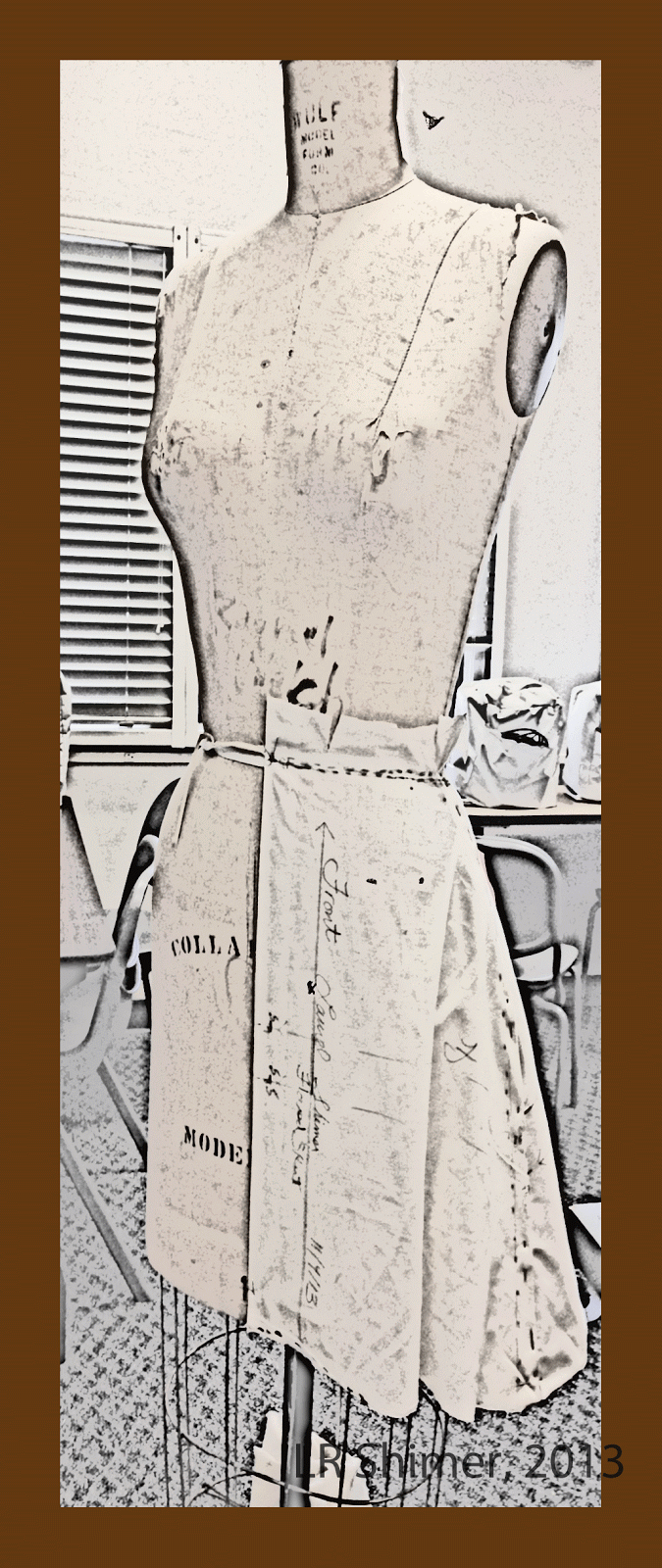
A flared skirt I draped in
Fashion Lab
You're right, that hem wasn't
yet even!
Before people sewed they draped. 
And we continue to drape today. 

Most of my buddies, both sewists and non-sewists, understand what I'm talking about when I say I bought a pattern, altered it to fit a little better, and sewed it up. But when I say I'm studying draping, they give me the funny look. When I explain what draping is, I get another look.

Draping is the most historic way of creating clothing. Long before people applied the first ancient bone needles and early threads to join pieces of fur or fabric together, they hung or draped clothing on themselves and others and found ways to fix those materials onto the body. 

You may have tied or wrapped stuff around your own or a dolls body at one point in your life, and achieved a serviceable garment. Ever tossed a hole-embellished sheet over your head, and been a ghost for Halloween? I know I achieved a lovely Roman goddess effect with a large blue sheet and a little twisting around my self and over one shoulder, back in sixth grade.

In most cases of early draping, the fabric was draped directly onto the body the piece of clothing was intended for. Eventually pins were added to hold things in place (If you can knap stone or bone to create an arrowhead, why not a pin?). By the time the Romans dominated the western world, many civilizations were using something along the lines of the Roman fibula, a kind of forerunner to the modern safety pin to hold longer clothes on. They were also pretty savvy about tying fitted workmanlike garments onto their bodies.

Stitching things in place came rather later in history. It was the tying, draping and arranging of fold and fabric that counted. 

Skipping forward quickly (did you know I'm an inveterate time traveller?) we find that though modern folks have invented the flat pattern method of clothing construction, clothing designers and sewists continue to use draping as either an alternate method of creating a pattern, or as a way of testing, altering or polishing the fit of a garment created with a flat pattern. 

I'm taking a draping class in order to develop skills I can use with my custom dress form. (You may also choose to buy dress forms that you can adjust to reflect your measurements.) That means I'll be better able to alter commercial patterns to fit me, in addition to beginning my journey into creating my own patterns. I also hope that someday I'll be bold enough to create a garment from scratch right on my custom form, just like the couture houses do for their high-end clients!

As I learn to drape, I'm learning more about this ancient art form, increasing my appreciation for historic garments, and developing a sense of why the lines of different pieces of clothing fall the way they do. 


Learning to drape, and studying the history of draping is the kind of thing that keeps me...
Enchanted by Sewing!


~ ~ ~
Resources

The profession known as a "draper", has an historical significance that goes back to medieval trade guilds. http://www.ask.com/wiki/Draper

You can drape on a person or on a dress form. When creating for ourselves, it's easiest to use the dress form approach!

In the September Enchanted by Sewing Audio Podcast Dress Forms Episode, I described my experiences creating two different dress forms. You can listen to this talk either online on the web, or you can download the show to your mobile device (like an iPhone, Android, etc.)
http://www.enchantedbysewing.blogspot.com/2013/09/ench-by-sew-12-dress-forms.html


I'm just beginning to learn the historic and modern art of draping. It's a very artistic experience !  I've begun to develop my skill set in a class taught through the CaƱada College Fashion Department. I'll be continuing my draping journey by continuing to follow the richly illustrated draping tutorials and examples in our class textbook, The Art of Fashion Draping. This excellent, and highly regarded book, by Connie Amaden-Crawford has been in use for decades. both within the industry, and by home sewists. 

Thanks Sponsors! 
When you buy products through links in this blog, you support the regular work of this blog and The Enchanted by Sewing Podcast.

Sunday, February 3, 2013

Antique Threads:My Life in Costume Drama (Poldark)


Demelza Poldark, in one of her beautiful
Empire Style Day Gowns,
Shown here giving husband Ross a piece of her mind
in the BBC series "Poldark",
Inspired by the novels of Winston Graham
In college and high school I sewed a goodly number of frocks along the lines of Demelza's in the BBC television series Poldark. The high waistlines of Empire dresses spoke not only to the style of the English Regency era, they were how we imagined we would live our lives. Did you live your life as though you were part of some kind of drama when you were that age too?

Nowadays I look to Demelza's dresses more for sewing inspiration as to color, pattern and  details then as clothing I might wear for a walk in the park. As I mentioned in the Enchanted By Sewing December podcast (Ench-004: Good Night My Someone), this kind of gown still inspires my nightgown sewing. I've been mulling over creating a romantically styled spring/summer nightgown inspired by this sort of dress and the Folkwear "Beautiful Dreamer" nightgown pattern I've got tucked away.

It's the men's clothing from that era that inspire my daytime, for-public-view garment sewing. I love the buttons, lapels and fabrics of men's vests and they way they combined with what we might now call a poet shirt.

Imagine what a Buck like Demelza's husband Ross Poldark would have said if he had met a time traveller from today and learned that one day, women would wear trousers as tight as his own!

Saturday, January 5, 2013

Vintage Threads: Lauren Bacall's Striped Blouse

So simple and so chic
OK, it helps when you look like Lauren Bacall, but...
What women isn't flattered by a classic striped blouse?
I wonder how many times I've watched the movie To Have and Have Not since I first saw it back in university days..... The story's still got it - the people seem as real to me as my neighbors. Despite Bacall's beauty and elegant wardrobe she's just another gal with a problem. Hemingway's tale isn't about celebrities, it's about regular folks with problems and this great film kept true to that message.

The checked suit Bacall wore when we first met her in this classic film, provides obvious inspiration for vintage sewing enthusiasts. Who doesn't admire that bias cut skirt swaying so alluringly against the roll of the starlet's hips, and the wonderful shaping and buttons on the jacket? We all want an outfit like that! But would it do much good for the job we'd imagine ourselves doing in a muggy hotel basement in wartime Martinique?

It's this blouse that I first spotted on Bacall in a scene with Hoagy Carmichael, that really takes me time traveling back to that hotel, and make me itch to recreate her vintage garment. Like the jeans and Oxford shirt that Humphrey Bogart wears in the movie, this chic, striped blouse is a classic any lady would still be glad to create and own. Wouldn't it look great on any woman?

Full-On View of Lauren Bacall in the Striped Outfit
It could be a blouse and skirt
Or a shirtwaist dress
But when I time travel back to Martinique, I'm
making my version up as a shirt tucked into jeans
Later on in the movie we see the full-on view of this beautifully striped garment. With a light belt wrapped around Lauren's waist it's hard to tell whether or not it's really a blouse worn tucked into a matching skirt, or a shirtwaist dress. Does it matter? In my mind I'm hanging out in the cellar of a Martinique hotel with the Resistance fighters, too. And of course I'm wearing an up to date version of  Bacall's outfit. Her skirt is history when it comes to roughing it, but this little striped beauty tucked into my favorite jeans is what I've got in mind for my role in the modern retake on this story. Classically as well as practically dressed, as I always like to be, I'm definitely gonna be ready to really help out  when the police come calling. 

Sunday, November 11, 2012

Vests: Another Piece of My Heart


At this point I had basted the reverse side
of a piece of brocade onto the corduroy vest front
I had just over 17" of cord for the front, leftover
from sewing pants, not enough for even one front length.

Take another little piece of 
my heart now, baby,  

Break another little bit of my heart now, darling.  


Have another little piece of my heart now, baby.

You know you got it, if it makes you feel good, Oh yes indeed.

* * *

Did you know that?
Like most people, I associate it with Janis Joplin

*    *    *

I'm just coming down off a piecing project, feeling a little bit like what Janis was singing about in this performance of  "Piece of My Heart".

Piecing always sounds so straightforward. I take two or more remnants of material, and combine them to make one. It always takes an awful lot more time to create, than I expect. My goal is to make it look arty, not like something I did because I ran short of fabric.

Well.... in truth I was short of fabric. I think I got the last three yards of this corduroy from my local Joannes. Apparently I wasn't the only sewer who found this print irresistible. Even the online Joannes  had only one yard of the fabric. OK, I admit that I put that last yard in my cart, just in case I wasn't happy with my vest. Or maybe I bought that final piece just because I love this material so much. Those long ago French textile merchants didn't name it cord  du roy - fabric of kings- for nothing!  

In fact, a shortage of goods inspires me to piece. It's a bit of time travel back to our past-times sewist ancestors. Scissors in hand, I'm spinning through the closest appropriate time portal to Depression times flour sack shirts,  late nights in the slave cabins stitching together scraps and ends from the big house, or needling together worn bits from different family members clothes - an art form that will one day be known as Sashiko,  after a hard day in the rice paddies.

Piecing lets me pay tribute to lessons learned from the folk who created more than utility garments, with very little on hand. It reminds me that clothing, even clothing with limited resources, can be  art. 


And maybe that's the most important time and place to be making art.

You know you got it, when it makes you feel good!

Here's what I had left from the corduroy
I made the decision not to cut any off below the pieced brocade band
because I thought the weight would be better if I kept as much as I had
At this point I had backed the front band with a long remnant of
silk organza (tough yet light), then stitched the corduroy to the organza-backed brocade


The back of the vest was what remained after a pair of linen pants
I made at the same time I sewed the cords.
I couldn't quite eek out enough for the linen back,
though I had more of it than I did the corduroy. But by this point
I wanted the brocade piece to wrap around from front to back anyway.

Coming Soon To This Blog!  A view of the whole vest (Yes, I finished it early this morning). I'm looking forward to doing a photo shoot of my entire Sewn With a Plan (SWAP) four garment mini-wardrobe, created for my Fashion 110 Introduction to Sewing Class at CaƱada.

* I take sewing classes in the CaƱada College Fashion Department, Redwood City, California


Tuesday, July 24, 2012

Sewing Inspired by Marie Antoinette (Part 2)

Sewing Project Inspired by a visit back to 1779
You might enjoy catching up on the first part of this article at Sewing Inspired by Marie Antoinette: Part 1


In my last posting, I made a slight reference to one of my recent trips back through time to Marie Antoinette's court at Versailles. So...wouldn't you like to hear more about this particular trip? 


When I first started taking these little jaunts my biggest bit of culture shock involved the state of royal sanitation. But, I'm not sure you really want the down-and-dirty on the suspicious puddles that kept turning up in unexpected corners of the palace's wood parquet floors. Let's just leave it that I manage to avoid tripping or slipping in the you-know-what and go on from there, OK?


In this particular case, I had elected a visit back to 1779, nine years after Antonia first arrived at court as a gentle, demur, Austrian archduchess. It's hard not to feel for a teenaged girl in her circumstances, even one with that bucks and standing of the entire Hapsburg empire behind her, isn't it?


Not being well-connected at court, and also not wanting to put in the way-beyond dawn to dusk travail of servitude, my Period Pilots guide recommended that I adopt the persona of an artist. After all if  Anne Vallayer-Coster could make it, why not me? I was please to find that the very accessible public galleries at the palace made it easy to establish myself at a little table among the fruit sellers, ribbon-merchants and other hawkers. I must admit, though, that I sadly missed having access to a digital camera during my time in the galleries. And oh, what I could have done with Photoshop and a few jpeg's to capture the joi-de-vivre and bustle of the thousands of vendors and visitors that thronged that incredibly accessible royal community. I mean...Mademoiselle Vallayer-Coster's Still Life with Ham would have been nothing to what I could have come up with. 


I like to say that one of my little peintures caused la Reine to gasp in excitement and send off a billet to one of her Buds at  the Royal AcadĆ©mie, but no such luck. Still, I got a chance to see her more than once as she promenaded by on her way to visit her little Mousseline. 


And you can just bet what this sewist was doing... That's right, checking out Madame Deficit's frocks. 


To Be Continued.. 

This Resource Might Come in Handy for your Own Travels
Marie Antoinette and the French Revolution 

Sunday, July 22, 2012

Sewing Inspired By Marie Antoinette (Part 1)


I'm pretty sure I'm not the only sewist with an enduring fascination for the ill-fated youngest daughter of Austrian Empress Maria Theresa. 


Thanks to Babylon Baroque for posting this lovely image of Marie Antoinette in one of her Court Dresses
(http://babylonbaroque.files.wordpress.com)
Marie Antoinette had the goods when it came to wardrobing. Any gal would feel like  Cinderella in one of those bow-bedecked, lace-trimmed confections. Of course the hairdo has got to go, and those pannier-enhanced court dresses were a real pain to learn to walk in, in little Antonia's case she had to learn to do the Versaille glide before she left home. Then there were the challenges of breathing in seventeenth-century corsets, something that the queen herself tried to avoid. In fact her Mama the Empress sent her daughter more than one scolding in regards to the letters she had received back in Austria, complaining about her daughter's abandonment of her hated corset.


Still, every time I've tripped back in time (those Period Pilots weekend specials are just too good a deal to pass up!) and spy Marie Antoinette in one of those luxurious rich fabrics, I head straight for my fabric stash when I get home. Surely I could pull off that heavily embroidered satin'y look in a nicely fitted blouse. Wouldn't it look great over  jeans? I know I've got a $6.99 a yard brocade somewhere in here...


(To Be Continued)